



Why Implant Alignment Matters in Hip Replacement (And How Robotics Ensures Precision)
When you walk, sit, climb stairs, or bend down, your hip joint acts as the central pivot of your entire body. It bears up to three to five times your total body weight with every single step.
When severe osteoarthritis, rheumatoid arthritis, or Avascular Necrosis (AVN) damages the ball-and-socket structure of the hip, total hip replacement surgery restores smooth, pain-free movement.
However, many patients assume that the success of a hip replacement depends solely on the material of the artificial joint (such as ceramic or titanium). In reality, there is a far more critical factor that dictates whether your new hip feels natural or causes long-term issues: implant alignment.
If you are evaluating hip replacement surgery in Rajkot or Saurashtra, here is a detailed breakdown of why sub-millimeter implant placement matters—and how modern robotic-assisted technology eliminates alignment errors.
What Does “Implant Alignment” Mean in Hip Replacement?
A natural hip joint is a ball-and-socket mechanism:
-
The Acetabulum (Socket): The cup-shaped socket in your pelvis.
-
The Femoral Head (Ball): The smooth top of your thigh bone that fits inside the socket.
During a total hip replacement, the damaged socket is lined with a durable metal cup (acetabular component), and the top of the thigh bone is replaced with a metal stem topped with a smooth ceramic or metal ball.
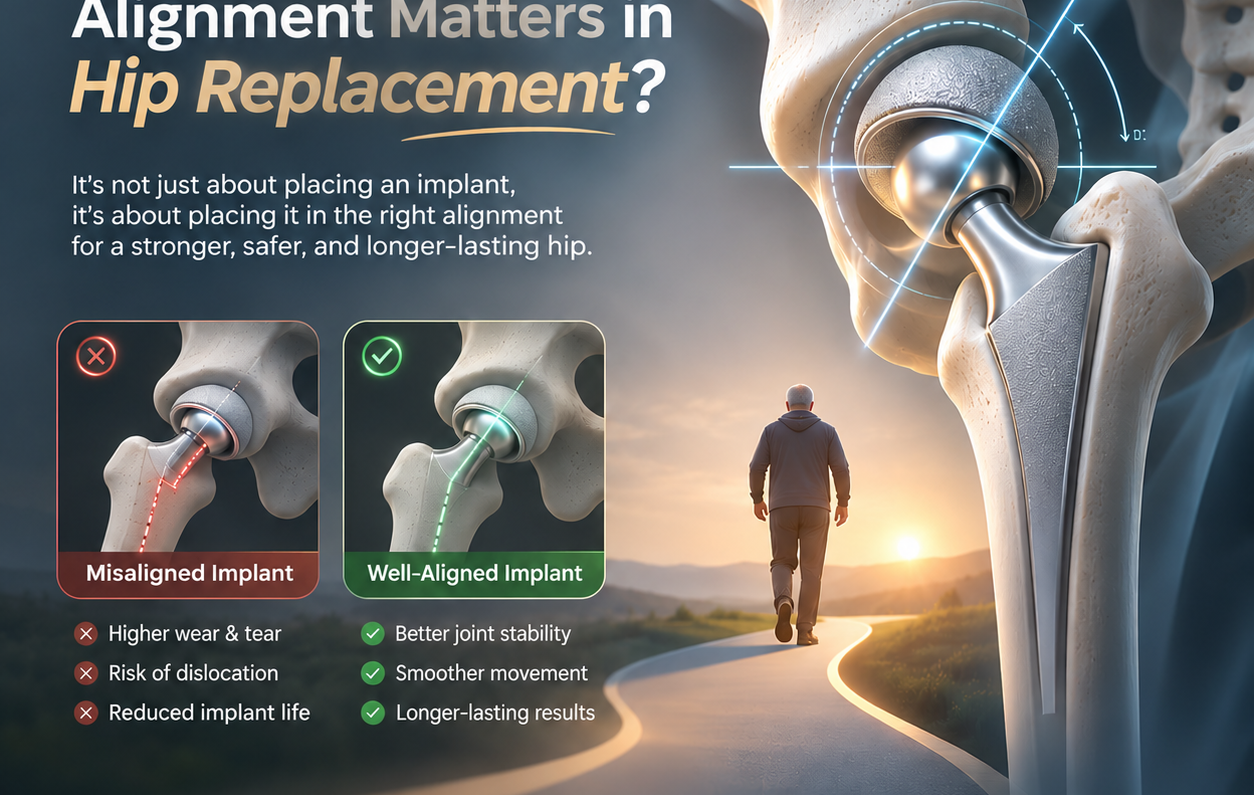
For the new joint to glide seamlessly, the prosthetic cup and stem must be positioned at exact anatomical angles customized to your unique pelvis. If an implant is tilted even a few degrees off-target, the biomechanics of your entire lower body are disrupted.
4 Clinical Consequences of Poor Hip Implant Alignment
When manual surgical guides rely purely on two-dimensional X-rays and visual estimation, minor rotational or angular variances can occur. Here is how poor alignment directly affects a patient:
1. Post-Operative Leg Length Discrepancy (LLD)
One of the most common complaints after traditional hip surgery is feeling like one leg is slightly longer or shorter than the other. Incorrect stem height or cup depth alters leg length, leading to an awkward gait, lower back pain, and the need for shoe lifts.
2. Higher Risk of Joint Dislocation
The artificial ball slipping out of its socket (dislocation) is a severe post-operative complication. If the acetabular cup is placed too steeply or tilted incorrectly (outside the anatomical “safe zone”), sudden bending or crossing legs can force the joint out of place.
3. Accelerated Implant Wear & Edge Loading
If the cup and ball do not articulate smoothly at the center, body weight concentrates on the edge of the socket (known as edge loading). This localized friction causes premature wear of the ceramic or polyethylene components, drastically shortening the joint’s lifespan.
4. Chronic Groin or Buttock Pain & Impingement
Improper cup orientation can cause the metal rim to rub against surrounding tendons (psoas muscle impingement), causing persistent groin or hip pain when walking or lifting the leg.
How Robotic Assistance (e.g., Mako SmartRobotics™) Guarantees Alignment Precision
Traditional hip replacement uses standardized mechanical alignment guides attached to the operating table. However, pelvic tilt changes when a person transitions from standing to sitting.
Robotic-assisted technology solves this by offering real-time 3D dynamic alignment:
| Alignment Factor | Traditional Manual Hip Surgery | Mako Robotic-Assisted Hip Surgery |
| Surgical Blueprint | 2D static X-ray templates | Patient-specific 3D CT scan reconstruction |
| Pelvic Tilt Tracking | Visual estimation during surgery | Live optical sensor tracking of pelvic movement |
| Cup Orientation Accuracy | ~3° to 5° variance margin | Sub-millimeter (<1 mm / <1°) accuracy |
| Leg Length Control | Manual intra-op measurement | Real-time digital readout of leg length & offset |
| Dislocation Prevention | Standard positioning rules | Personalized “Safe Zone” mapping tailored to patient spine-pelvis motion |
The 3-Step Robotic Precision Workflow
-
Pre-Operative 3D Modeling: A high-resolution CT scan captures the exact tilt, depth, and bone structure of your pelvis. The surgeon pre-plans the precise size and angle of the implant on screen before entering the operating room.
-
Real-Time Dynamic Assessment: Optical tracking pins placed on the pelvis allow the Mako system to calculate live joint stability and leg length as the surgeon checks the range of motion.
-
Surgeon-Guided Robotic Reaming: When preparing the pelvic socket, the robotic arm holds the reamer at the exact calculated angle. It prevents over-reaming of healthy pelvic bone and ensures the cup is pressed into position with absolute fidelity to the digital plan.
Long-Term Benefits for Patients in Rajkot
By ensuring pristine implant alignment, robotic hip replacement delivers distinct long-term outcomes:
-
Equal Leg Lengths: Walk naturally without limp or hip imbalance from Day 1.
-
Minimized Dislocation Risk: Freedom to bend, sit comfortably, and resume daily household and work activities with confidence.
-
Extended Implant Longevity: Evenly distributed weight friction allows modern ceramic-on-polyethylene bearings to last 20 to 25+ years.
-
Tissue-Preserving Recovery: Precise bone preparation avoids unnecessary muscle detachment, leading to shorter hospital stays (2–3 days).
Expert Hands Guiding Global Technology: Dr. Ketan Shah
While robotic systems provide unmatched data and boundary safety, the ultimate success of hip replacement relies on senior clinical judgment—assessing bone quality, selecting optimal implants, and tailoring recovery.
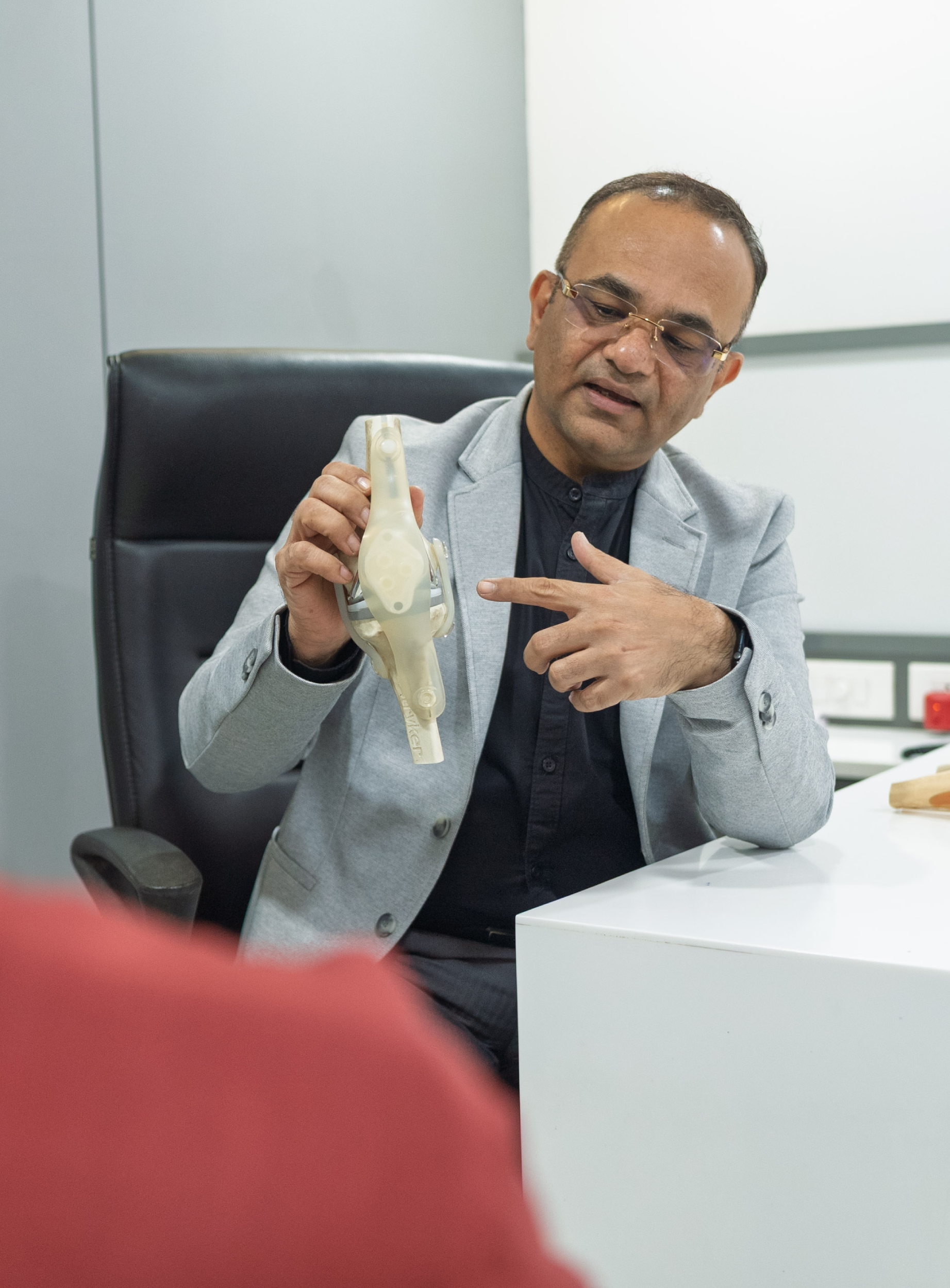
At Prabhukrupa Hospital in Rajkot, robotic hip procedures are planned and executed by Dr. Ketan Shah:
-
21+ Years of Dedicated Arthroplasty Experience: Saurashtra’s first DNB-credentialed exclusive joint replacement surgeon (since 2003).
-
Mastery in AVN & Complex Hip Surgeries: Hundreds of successful primary and revision hip replacements performed for patients across Gujarat.
-
Stryker National Faculty & Mentor: Actively training senior orthopaedic specialists in advanced robotic hip and knee procedures.
Reclaim Your Natural, Balanced Gait Today
You don’t have to accept chronic hip stiffness or compromise on surgical precision. With Mako SmartRobotics™ at Prabhukrupa Hospital in Rajkot, international-standard hip replacement care is available right in your home region.
Schedule a Hip Alignment & AVN Evaluation
If you suffer from deep hip pain, stiffness, or limp while walking, consult with Dr. Ketan Shah for a personalized 3D joint evaluation.
-
Hospital Location: Prabhukrupa Hospital, Opposite Senior Citizen Park, Near Jubilee Garden, Kasturba Road, Rajkot – 360001.
-
Appointment Helpline: +91 9898 778 541
-
Official Website: drketanshahortho.com | prabhukrupahospital.com