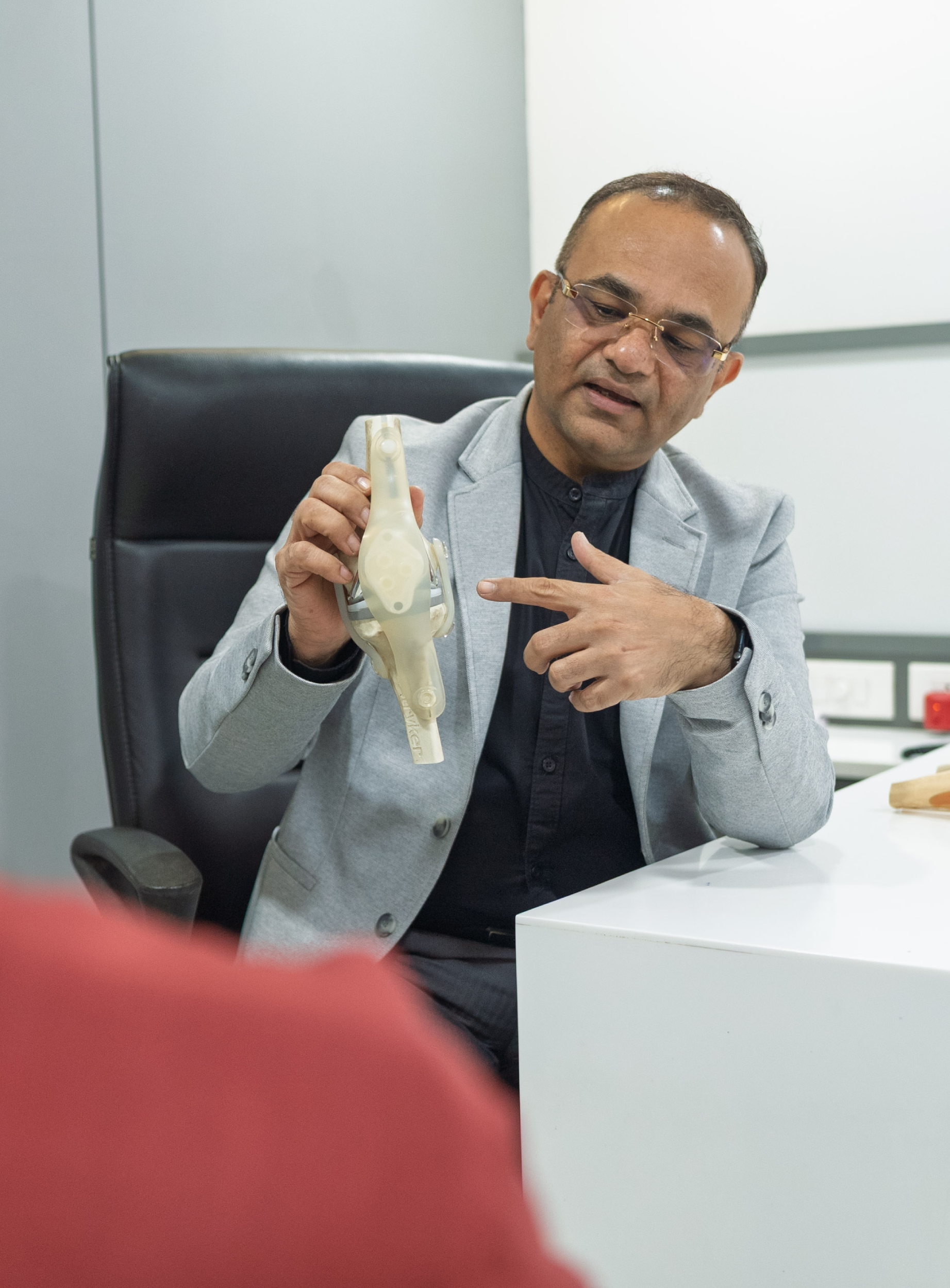




Once you decide to undergo knee replacement surgery, your thoughts naturally shift from the operation itself to what comes after:
“How quickly can I stand up?”, “When will I be able to walk without support?”, and “When can I get back to driving, traveling, or doing household work independently?”
One of the biggest advantages of Mako SmartRobotics™ assisted knee replacement is how significantly it transforms the rehabilitation experience. Because sub-millimeter robotic precision prevents unnecessary damage to surrounding muscles, ligaments, and soft tissues, post-surgical trauma is minimized—leading to faster mobilization and smoother recovery.
If you or a loved one in Rajkot or Saurashtra are preparing for surgery, here is your definitive, week-by-week guide to what recovery looks like after robotic knee replacement.
At-a-Glance Recovery Milestones
[ Day 1 (24 Hours) ] ➔ First steps with walker & standing exercise
                                  ↓
[ Days 2 – 3 ]       ➔ Stair climbing practice & hospital discharge
                                  ↓
[ Weeks 2 – 3 ]      ➔ Walking indoors with stick / unassisted; stitches removed
                                  ↓
[ Weeks 4 – 6 ]      ➔ Return to driving, office work, cooking & outdoor walks
                                  ↓
[ Months 2 – 3 ]     ➔ Full activity, traveling, and natural joint movement
Detailed Week-by-Week Recovery Breakdown
Phase 1: Day 1 to Discharge (Days 1–3) — Immediate Mobilization
The old approach of staying in bed for several days after joint surgery is long gone. Modern protocols focus on getting your new joint moving safely within hours.
-
Day 1 (Within 24 Hours): With local targeted pain management and nerve blocks in place, a physiotherapist will help you stand up and take your first steps using a walker. You will also begin basic bed exercises (ankle pumps and thigh squeezes) to boost blood circulation.
-
Day 2: You will practice walking longer distances down hospital corridors with a walker, learning how to safely sit down, stand up, and bend your knee to 90 degrees.
-
Day 3 (Discharge Day): Once you can comfortably walk, use the bathroom independently, and navigate a short flight of test stairs with support, you are discharged to return home safely.
Phase 2: Weeks 1 to 2 — Home Transition & Wound Healing
During these two weeks, your primary focus is managing mild swelling, practicing daily home exercises, and protecting the surgical incision.
-
Walking & Movement: You will use a lightweight walker or crutches around your home to maintain balance. Short, frequent walks inside your house are far more beneficial than long, exhausting sessions.
-
Swelling & Pain Management: Applying ice packs 3 to 4 times a day and keeping your leg elevated while resting helps clear post-surgical fluid. Pain is well-controlled with prescribed medications.
-
Knee Flexion Goal: Reaching 90° to 100° knee bend by the end of Week 2.
-
Stitching / Dressing Care: At the end of Week 2, you will visit Prabhukrupa Hospital for your first post-op follow-up check and wound inspection.
Phase 3: Weeks 3 to 4 — Gaining Independence & Dropping Supports
This phase brings a noticeable surge in confidence as strength returns to your quadriceps muscles.
-
Support Transition: Most robotic knee replacement patients comfortably transition from a walker to a simple walking stick—or begin walking completely unassisted indoors.
-
Daily Activities: You can comfortably dress yourself, prepare light meals, sit at a dining table, and move around your home without help.
-
Physical Therapy: Exercises shift toward building leg strength, improving balance, and achieving 110° to 120° knee bending.
Phase 4: Weeks 5 to 6 — Returning to Active Life & Driving
By Week 6, the initial healing phase is complete, and your artificial joint feels far more integrated with your natural movement.
-
Outdoor Mobility: You can take outdoor walks around your neighborhood or local gardens comfortably without support.
-
Driving & Work: If you operated on your left knee (or operate an automatic vehicle), driving can usually be resumed around Weeks 4 to 6 once your reaction times normalize. Working professionals can comfortably return to office routines.
-
Stairs & Flexibility: Climbing and descending stairs using alternating feet becomes easier as muscle strength rebuilds.
Phase 5: Months 2 to 3 — Complete Recovery & Enjoying Your New Joint
By Month 3, your soft tissues have fully adapted to the artificial implant.
-
Full Range of Motion: Reaching full knee extension (completely straight leg) and 125°+ knee flexion, allowing you to sit comfortably during long journeys, attend family functions, and enjoy long walks.
-
Returning to Hobbies: You can enjoy low-impact sports, travel, stationary cycling, and active daily life with zero joint pain.
Traditional vs. Robotic Recovery Timeline
| Recovery Parameter | Traditional Manual Knee Surgery | Mako SmartRobotics™ Surgery |
| First Steps Taken | Day 2 or 3 | Day 1 (Within 24 Hours) |
| Hospital Stay Duration | 4 to 6 days | 2 to 3 days |
| Transition Off Walker | Week 4 to 6 | Week 2 to 3 |
| Post-Op Pain & Tissue Trauma | Moderate to high due to muscle stretching | Significantly reduced due to tissue-sparing precision |
| Physiotherapy Duration Needed | 8 to 12 weeks of intensive rehab | 3 to 4 weeks of structured home exercises |
| Return to Normal Routines | 8 to 12 weeks | 4 to 6 weeks |
4 Practical Tips for a Speedier Recovery at Home
-
Prepare Your Home Before Surgery: Clear clutter and loose rugs from hallways, ensure good lighting along paths to the bathroom, and place a stable chair with arms in your living area.
-
Commit to Daily Exercises: Consistent, short physical therapy sessions (15–20 minutes, 2 to 3 times a day) yield far better results than occasional heavy workouts.
-
Stay Ahead of Pain Management: Take your prescribed anti-inflammatory and pain-relief medications on schedule during the first two weeks so discomfort does not hold you back from exercising.
-
Use Ice Packs Frequently: Cold therapy for 15 minutes after exercise sessions is the single best way to minimize joint warmth and swelling.
Guided Recovery with Saurashtra’s Joint Specialist: Dr. Ketan Shah
Successful joint replacement doesn’t end in the operating room—it relies heavily on experienced post-operative care and rehabilitation protocols.
At Prabhukrupa Hospital in Rajkot, your surgical and recovery journey is overseen by Dr. Ketan Shah:
-
21+ Years of Arthroplasty Leadership: Saurashtra’s first DNB-credentialed exclusive joint replacement surgeon (since 2003).
-
Dedicated Rehabilitation Support: Providing personalized recovery roadmaps and structured physiotherapist coordination for every patient.
-
Pioneering Local Robotic Care: Offering world-standard Mako SmartRobotics™ joint care to families across Rajkot, Jamnagar, Junagadh, Amreli, and all of Saurashtra.
-
Stryker National Faculty & Mentor: Training orthopaedic specialists nationwide in advanced joint replacement and rapid recovery protocols.
Reclaim Your Pain-Free Mobility Today
Recovery after knee replacement is no longer a months-long ordeal. With Mako SmartRobotics™ technology, walking without pain is achievable far sooner than you think.
Visit Prabhukrupa Hospital in Rajkot to learn more about robotic knee replacement and plan your path back to an active life.
Schedule a Joint Evaluation
-
Hospital Location: Prabhukrupa Hospital, Opposite Senior Citizen Park, Near Jubilee Garden, Kasturba Road, Rajkot – 360001.
-
Appointment Helpline: +91 9898 778 541
-
Official Website: drketanshahortho.com | prabhukrupahospital.com