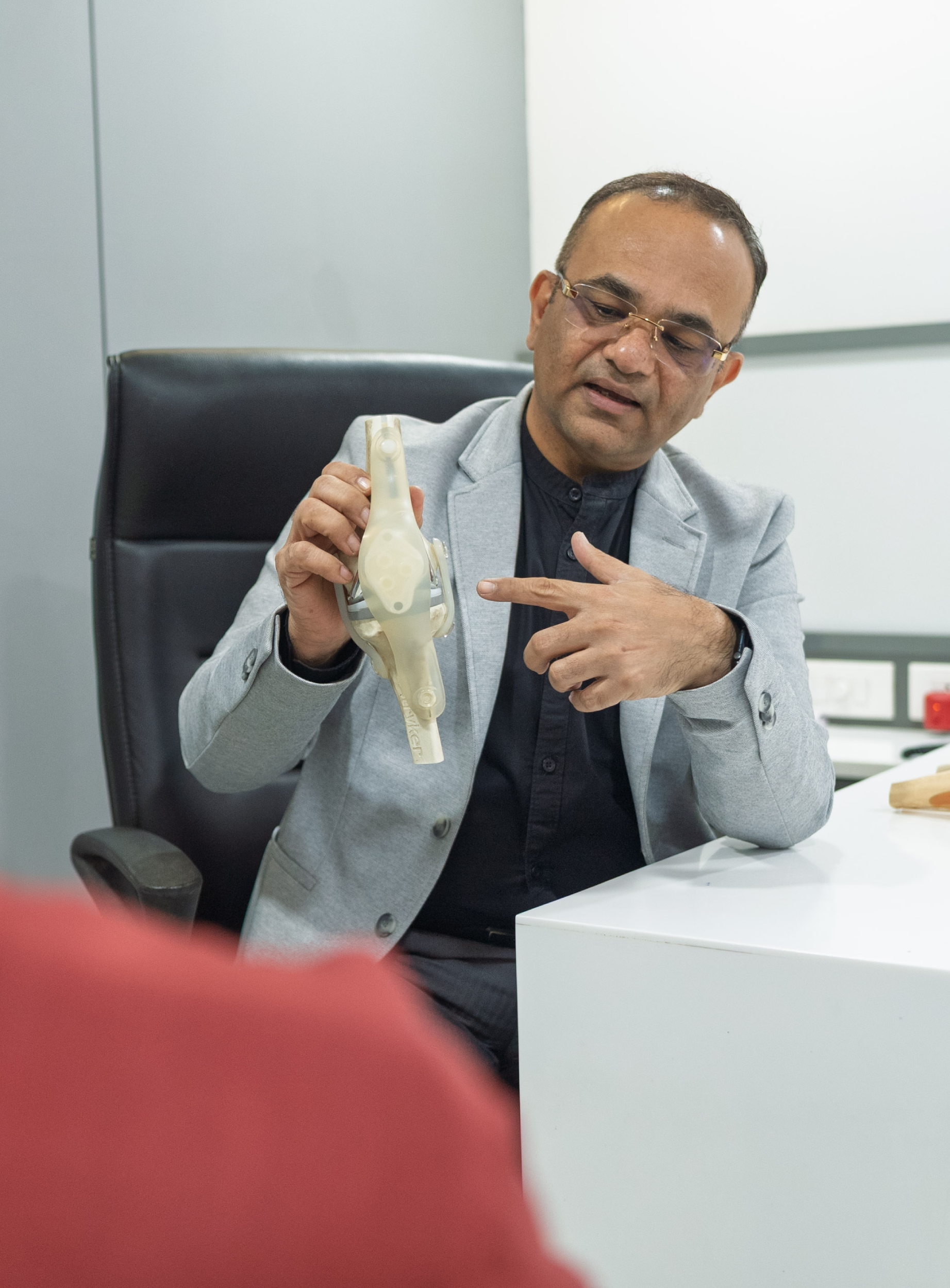




When knee pain begins to interfere with your daily routine—making a morning walk around Racecourse Baug or standing during family gatherings difficult—most people try everything possible to avoid surgery.
It is completely natural to look for non-invasive alternatives. One of the most common questions patients ask during an orthopedic consultation in Rajkot is:
“Doctor, can targeted exercises, physiotherapy, and lifestyle changes help me delay or completely avoid a knee replacement?”
The short answer is yes, but it depends heavily on your stage of arthritis.
Targeted exercises and non-surgical treatments can significantly relieve pain and delay surgery during the early and moderate stages of joint wear. However, when joint breakdown reaches severe, bone-on-bone friction, relying on exercise alone can lead to further joint damage and persistent pain.
Here is an evidence-based look at how targeted exercises protect your knees, the limits of non-surgical joint care, and how to know when it is time to transition to advanced solutions like robotic knee replacement.
How Exercises Help Protect Your Knee Joint
Your knee joint does not rely solely on bone and cartilage to stay stable. A complex network of muscles, tendons, and ligaments acts as a natural shock-absorption system.
               [ Strengthen Quadriceps & Hamstrings ]
                                 ↓
            [ Off-load Pressure from Damaged Cartilage ]
                                 ↓
              [ Improved Joint Balance & Stability ]
                                 ↓
        [ Reduced Daily Pain & Slowed Arthritis Wear ]
When you perform targeted low-impact exercises, several clinical benefits occur:
-
Muscle Off-Loading: Strong quadriceps (front thigh muscles) and hamstrings (back thigh muscles) absorb much of the mechanical impact during walking, reducing direct friction on damaged cartilage.
-
Improved Synovial Fluid Circulation: Gentle joint movement encourages the flow of synovial fluid—the body’s natural joint lubricant—keeping cartilage nourished and easing morning stiffness.
-
Weight Management: Every kilogram of body weight lost reduces mechanical pressure on your knees by 3 to 4 kilograms per step.
Recommended Exercises for Joint Health (Stages 1–3 Osteoarthritis)
If your arthritis is in the early to moderate stages, incorporating these low-impact exercises into your daily routine can help manage symptoms and prolong natural joint function:
| Exercise Type | Recommended Activities | Clinical Benefit |
| Isometric Quad Sets | Straight leg raises, seated leg extensions with ankle weights | Strengthens front thigh muscles without compressing the knee joint |
| Low-Impact Cardio | Stationary cycling, water aerobics, swimming | Keeps joints moving smoothly with zero impact shock |
| Hamstring & Calves Stretching | Seated towel stretches, gentle standing calf stretches | Prevents muscle tightness and improves knee extension flexibility |
| Core & Glute Building | Seated bridges, mini-squats with chair support | Improves overall leg alignment and pelvis stability while walking |
Exercises to AVOID if You Have Knee Arthritis:
-
Deep Squats or Full Lunges: Places excessive compression pressure behind the kneecap.
-
High-Impact Running or Jumping: Causes repeated shock friction on thinning cartilage.
-
Stair Climbing for Fitness: Pushes force up to 5 times your body weight onto damaged joints.
Non-Surgical Joint Care: What Works and What Has Limits
Exercise is just one part of a non-surgical joint preservation plan. Here is how common conservative treatments compare:
-
Physiotherapy & Guided Rehab: Highly effective in Stages 1–3 to correct gait imbalances, build muscle strength, and maintain joint flexibility.
-
Unloader Knee Braces: Shifts body weight away from the damaged side of the knee (usually the inner compartment), offering temporary relief during walking.
-
Intra-Articular Injections (Hyaluronic Acid / PRP): Provides temporary joint lubrication and reduces inflammation for 6 to 12 months in early to moderate arthritis.
-
Medications & Supplements: Glucosamine and chondroitin may support early cartilage health, but they cannot regrow lost bone or severe cartilage loss.
The Turning Point: When Exercises Are No Longer Enough
While exercise is valuable, it is important to understand its biological limits: exercise can strengthen the muscles around a joint, but it cannot regrow worn cartilage or straighten a bowed bone.
[ Stage 1 to 3 Osteoarthritis ] ➔ Exercises, rehab, and lifestyle changes offer relief.
                                            ↓
[ Stage 4 Bone-on-Bone Wear ]   ➔ Cartilage is gone; exercise causes pain & further wear.
                                            ↓
[ Definitive Solution ]         ➔ Robotic Joint Replacement restores alignment & mobility.
Signs You Have Reached the Limits of Non-Surgical Care:
-
Severe Pain During Low-Impact Exercise: Even gentle walking or stationary cycling causes sharp, throbbing pain.
-
Bone-on-Bone Friction on X-Rays: X-rays show complete cartilage loss (Stage 4 Osteoarthritis) with zero gap between thigh and shin bones.
-
Progressive Leg Deformity: Your legs have developed a bow-legged (varus) shape due to uneven bone wear.
-
Night Pain & Sleep Disruption: Joint pain wakes you up continuously, despite taking medications or using heat packs.
-
Loss of Daily Independence: You avoid traveling, family functions, or basic errands because walking feels overwhelming.
What Happens When You Need Surgery? The Robotic Advantage
When conservative measures no longer provide relief, delaying surgery unnecessarily can lead to progressive muscle weakness, back pain, and loss of overall health due to inactivity.
At this stage, Total or Partial Knee Replacement offers a predictable, long-term solution. Modern Mako SmartRobotics™ Technology at Prabhukrupa Hospital in Rajkot has transformed joint surgery:
[ Pre-Op 3D CT Scan ] ➔ Custom digital model maps exact anatomy down to < 1 mm
                                 ↓
[ Haptic Safety Protection ] ➔ Preserves healthy bone, soft tissue, and ligaments
                                 ↓
[ Precision Balancing ] ➔ Implants feel balanced, natural, and extend joint life (20-25+ years)
                                 ↓
[ Rapid Mobilization ] ➔ Stand and walk within 24 hours; home in 2-3 days
-
Sub-Millimeter Precision: Implants are customized to your unique bone shape, distributing weight evenly.
-
Preserving Soft Tissue: Minimizes muscle trauma, resulting in significantly lower post-operative pain and swelling.
-
Faster Return to Exercise: Precise alignment allows patients to return to pain-free walking, cycling, traveling, and an active lifestyle within weeks.
Expert Joint Preservation & Surgical Guidance: Dr. Ketan Shah
Knowing whether to continue exercise therapy or evaluate joint replacement requires experienced clinical judgment. At Prabhukrupa Hospital in Rajkot, joint care is led by Dr. Ketan Shah:
-
21+ Years of Arthroplasty Leadership: Saurashtra’s first DNB-credentialed exclusive joint replacement surgeon (since 2003).
-
Ethical Diagnostic Benchmark: Advocates non-surgical management and guided physical therapy for early-stage arthritis, recommending surgery only when Stage 4 bone-on-bone joint failure is established.
-
Pioneering Local Robotic Care: Bringing global-standard Mako SmartRobotics™ technology directly to families in Rajkot and across Saurashtra.
-
Stryker National Faculty & Mentor: Training orthopaedic specialists nationwide in advanced joint replacement protocols.
Find the Right Balance for Your Knee Health
Targeted exercises are your first line of defense against early arthritis. But when cartilage loss becomes severe, holding off on needed joint care can compromise your mobility and independence.
Visit Prabhukrupa Hospital in Rajkot for a personalized joint stage evaluation to see if exercise therapy or modern joint replacement is the best path forward for you.
Book Your Joint Assessment
-
Hospital Location: Prabhukrupa Hospital, Opposite Senior Citizen Park, Near Jubilee Garden, Kasturba Road, Rajkot – 360001.
-
Appointment Helpline: +91 9898 778 541
-
Official Website: drketanshahortho.com | prabhukrupahospital.com