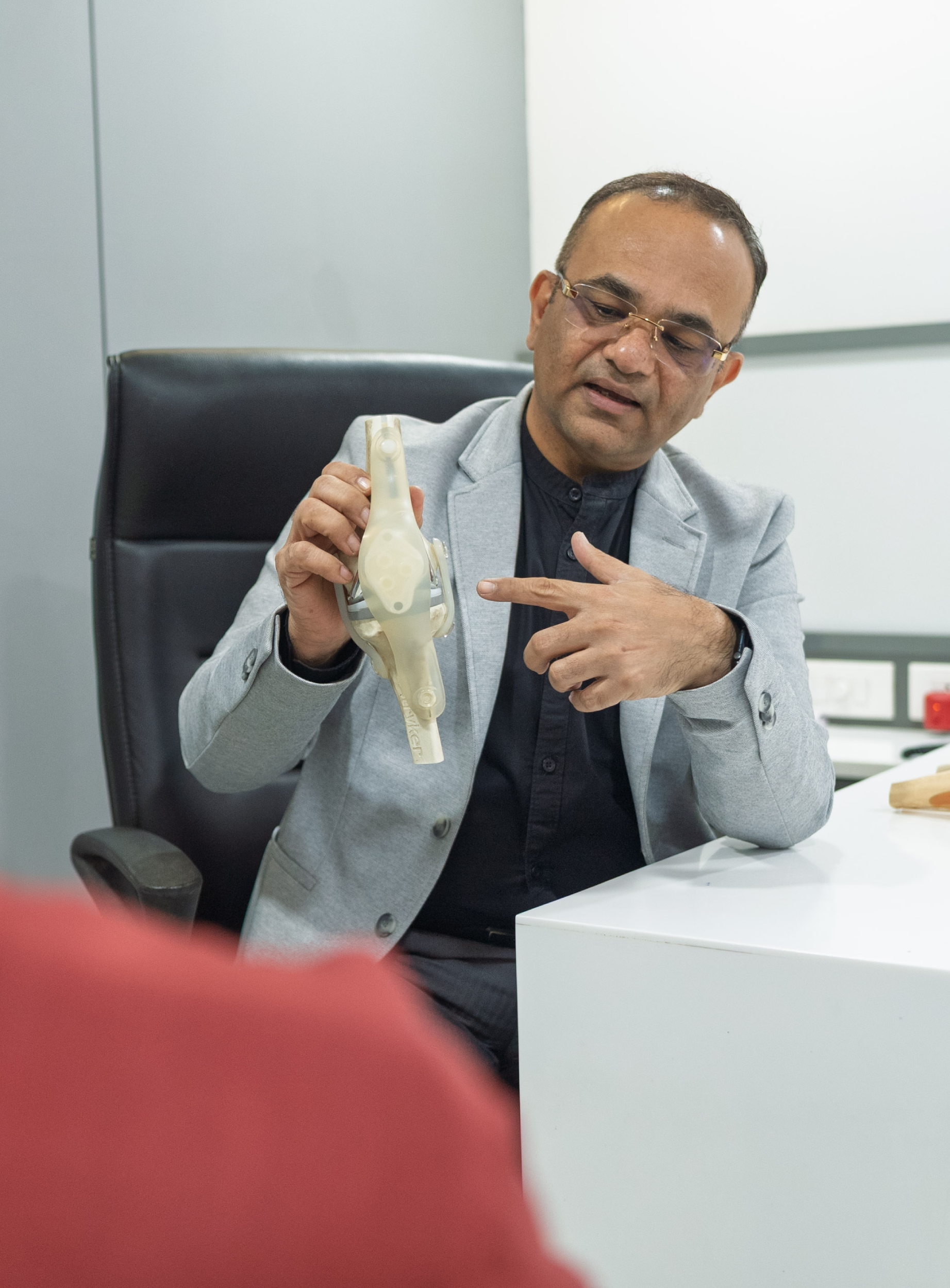




For anyone suffering from severe hip pain—whether caused by advanced osteoarthritis or Avascular Necrosis (AVN)—the decision to undergo total hip replacement surgery comes with one dominant question:
“How long will I be stuck in bed, and how soon can I actually stand up and walk independently?”
Historically, patients feared hip replacement because traditional methods often meant weeks of strict bed rest, long hospital stays, and a slow, painful rehabilitation process.
Today, advanced Mako SmartRobotics™ technology in Rajkot has completely rewritten the surgical recovery playbook. By combining sub-millimeter anatomical accuracy with tissue-sparing techniques, patients are standing and taking supported steps far sooner than ever imagined.
If you or a loved one in Saurashtra are planning for a hip replacement, here are the real recovery expectations, step-by-step walking timelines, and practical tips for a seamless return to an active life.
The Short Answer: When Do You Take Your First Steps?
[ Surgery Completed ] ➔ [ 4-6 Hours: Local Targeted Anesthesia Wears Off ]
                                         ↓
[ Day 1 (Within 24 Hours) ] ➔ STAND UP & WALK WITH A WALKER
                                         ↓
[ Days 2 – 3 ]              ➔ CLIMB TEST STAIRS & RETURN HOME
                                         ↓
[ Weeks 2 – 3 ]             ➔ WALK UNASSISTED INDOORS & DROPPING WALKER
Most patients stand and take their first steps with a walker on Day 1 (within 24 hours of surgery).
Because robotic assistance eliminates guesswork in implant alignment and preserves healthy surrounding muscles, you do not have to wait for tissues to slowly repair themselves before putting weight on your new hip.
Timeline: Day-by-Day Walking & Mobility Expectations
Phase 1: The Hospital Experience (Days 1 to 3)
-
Day 1 (Surgery Day / First 24 Hours): Once regional anesthesia and nerve blocks stabilize, a specialized physiotherapist helps you swing your legs out of bed, stand up, and walk down the hospital corridor using a lightweight walker. Taking these early steps boosts blood circulation and prevents deep vein thrombosis (DVT).
-
Day 2: You will practice walking longer distances, sitting and standing independently from chairs, and learning how to step in and out of the bathroom safely.
-
Day 3 (Discharge Day): You will demonstrate climbing a short flight of test stairs with support. Once you can walk comfortably and manage basic personal care, you are discharged to return home safely.
Phase 2: Weeks 1 & 2 — Building Domestic Independence
-
Walking Capacity: You will use a walker or elbow crutches inside your home to maintain balance while your surgical incision heals.
-
Focus: Short, frequent 5-to-10-minute walks around the house throughout the day are far more effective than long, exhausting walks.
-
Leg Length & Alignment: Because robotic CT planning eliminates leg length discrepancies, your gait feels balanced and natural right from the start—with zero awkward limping.
-
Sutures & Follow-Up: At the end of Week 2, you will visit Prabhukrupa Hospital for your first post-operative checkup and wound inspection.
Phase 3: Weeks 3 & 4 — Transitioning Away from Support
-
Walking Unassisted: Most robotic hip replacement patients comfortably drop their walker by Week 2 or 3, transitioning to a lightweight single cane or walking unassisted around the house.
-
Daily Routines: You can easily move around your kitchen, prepare meals, sit comfortably at dining tables, and manage household chores without help.
-
Flexibility: Hip bending and leg rotation feel natural and fluid, making dressing and moving around effortless.
Phase 4: Weeks 5 to 8 — Returning to Outdoor Driving, Work & Hobbies
-
Outdoor Walking: You can comfortably enjoy outdoor walks around your neighborhood or local parks without any walking aids.
-
Driving: If you had surgery on your left hip (or drive an automatic car), driving can usually be resumed around Weeks 4 to 6 once your leg reaction times normalize.
-
Return to Work: Professionals can comfortably return to office environments, business meetings, and light travel.
Why Robotic Hip Replacement Speeds Up Walking Recovery
Traditional hip replacement relies on visual estimation and manual jigs to place the socket cup and femoral stem. If an implant is slightly tilted or misaligned, muscles have to work extra hard to stabilize the joint, leading to post-operative pain, limp, and delayed walking.
Mako SmartRobotics™ transforms recovery through 3 key factors:
| Recovery Factor | Traditional Manual Hip Surgery | Mako SmartRobotics™ Hip Surgery |
| Leg Length Balance | Manual estimation; risk of slight leg imbalance | Sub-millimeter CT digital matching; zero leg discrepancy |
| Joint Stability | Standard positioning rules | Custom cup positioning in your anatomical “Safe Zone” |
| Dislocation Risk | Higher initial risk during early movement | Extremely low risk; allows confident early walking |
| Soft Tissue Trauma | Greater muscle detachment & retraction | Tissue-sparing precision; minimal muscle disruption |
| Hospital Stay | 4 to 6 days average stay | 2 to 3 days (Rapid discharge protocol) |
4 Rules for Safe Walking Recovery at Home
To ensure your walking recovery goes smoothly without setbacks, follow these simple guidelines:
-
Keep Paths Clear: Clear throw rugs, loose electrical cords, and clutter from walkways between your bedroom, living area, and bathroom.
-
Use a High, Stable Chair: Sit in chairs with firm cushions and armrests. Avoid soft, low sofas that cause your hips to sink below your knees during the first few weeks.
-
Pace Your Activity: Balance short, frequent walks with resting and elevating your leg to manage mild post-operative swelling.
-
Follow Guided Physical Therapy: Perform your prescribed daily hip-strengthening exercises to rebuild your gluteal muscles and maintain a stable, effortless gait.
Expert Hip Care in Rajkot: Dr. Ketan Shah
Getting back on your feet quickly and safely depends heavily on senior surgical experience and advanced institutional infrastructure.
At Prabhukrupa Hospital in Rajkot, your hip replacement journey is personally planned and conducted by Dr. Ketan Shah:
-
21+ Years of Arthroplasty Leadership: Saurashtra’s first DNB-credentialed exclusive joint replacement surgeon (since 2003).
-
Mastery in AVN & Complex Hip Care: Hundreds of successful joint preservation and complex robotic hip replacements performed for patients across Gujarat.
-
Pioneering Local Robotic Infrastructure: Bringing global-standard Mako SmartRobotics™ hip technology directly to families in Rajkot and across Saurashtra.
-
Stryker National Faculty & Mentor: Training orthopaedic specialists nationwide in advanced joint replacement and rapid recovery protocols.
Reclaim Pain-Free Walking with Confidence
Hip replacement is no longer a procedure that keeps you bedridden for weeks. With Mako SmartRobotics™ technology, standing up and taking your first steps happens within 24 hours of surgery.
Visit Prabhukrupa Hospital in Rajkot to discuss your hip pain and plan your path back to independent mobility.
Book Your Hip Consultation
-
Hospital Location: Prabhukrupa Hospital, Opposite Senior Citizen Park, Near Jubilee Garden, Kasturba Road, Rajkot – 360001.
-
Appointment Helpline: +91 9898 778 541
-
Official Website: drketanshahortho.com | prabhukrupahospital.com