



5When patients consider knee replacement surgery, one of their chief concerns—especially for individuals in their 40s, 50s, or active 60s—is durability:
“How long will my new knee last? Will I need another major operation when I am older?”
Historically, patients were told that an artificial knee joint lasts roughly 15 to 20 years. While that was a solid benchmark for traditional manual procedures, advancements in Mako SmartRobotics™ technology are shifting these expectations.
Today, robotic precision is helping artificial knee implants achieve optimized weight distribution and fluid articulation, allowing modern joints to comfortably last 20 to 25 years or more.
If you are evaluating knee replacement in Rajkot or Saurashtra, here is a detailed clinical look at why artificial joints wear out over time—and how robotic technology protects your knee for decades to come.
Why Do Artificial Knee Joints Wear Out?
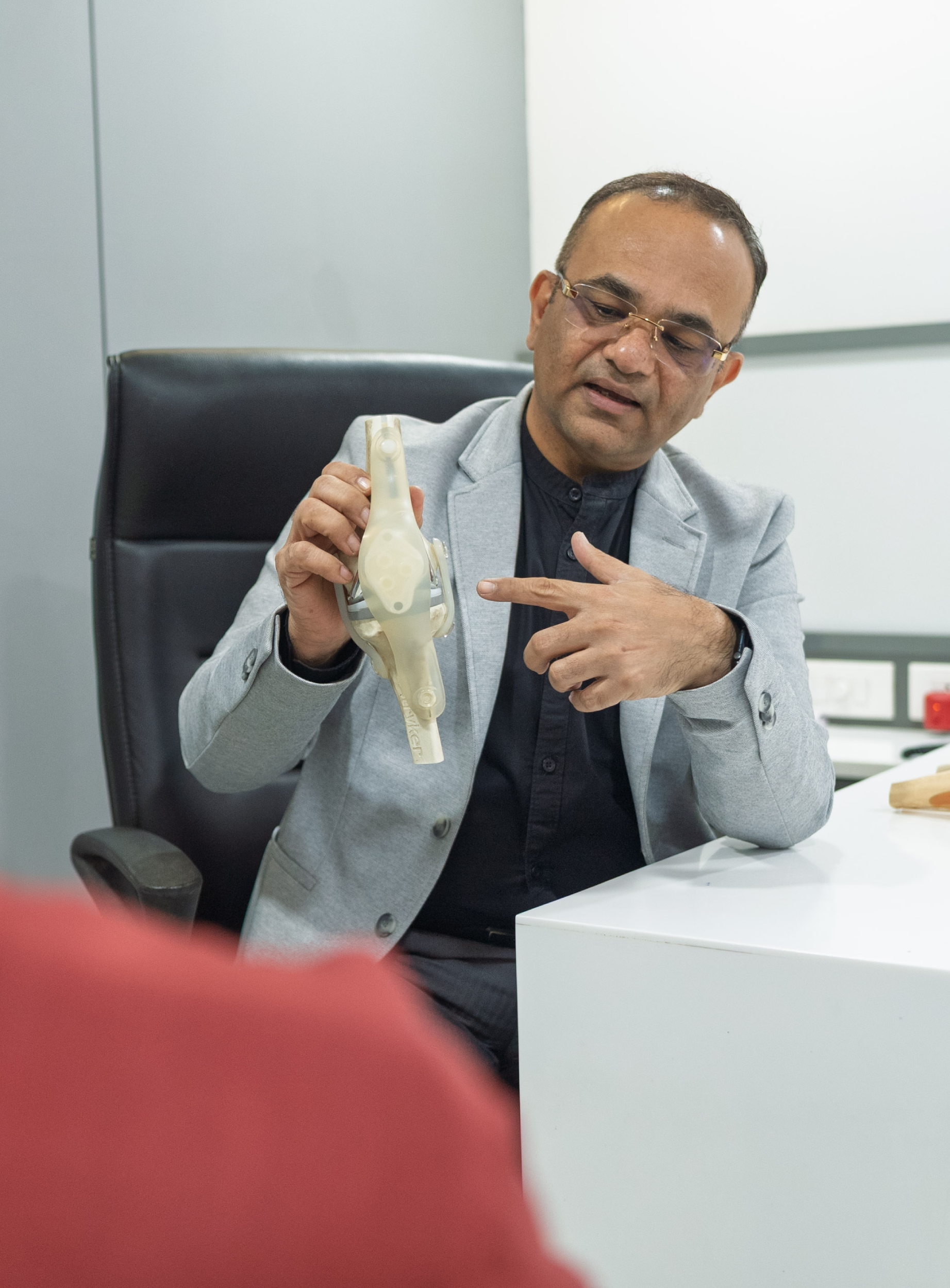
An artificial knee joint consists of three main components:
-
Femoral Component: A smooth metal cap attached to the end of the thigh bone.
-
Tibial Component: A durable metal tray fitted onto the top of the shin bone.
-
Polyethylene Spacer: A high-grade plastic insert placed between the metal parts to mimic natural cartilage.
                  [ Body Weight & Daily Walking Pressure ]
                                     ↓
              [ Minor Manual Misalignment (Even 2° - 3°) ]
                                     ↓
                [ Uneven Friction & Edge Loading ]
                                     ↓
         [ Accelerated Plastic Wear → Joint Loosening (10-15 Yrs) ]
When you walk, bend, or climb stairs, the metal femoral component glides over the plastic spacer. Over millions of steps, this friction gradually wears down the plastic insert.
If an implant is placed with even a tiny manual alignment error (such as a 2-millimeter tilt or slight rotational offset), body weight is no longer distributed evenly across the joint. Instead, force concentrates heavily on one side—a phenomenon known as uneven loading.
Uneven loading causes rapid plastic wear, tissue inflammation, and eventual loosening of the metal components from the bone, making revision (redo) surgery necessary.
4 Ways Robotic Technology Extends Joint Longevity
Robotic-assisted knee replacement prevents premature implant failure by eliminating the root causes of wear and mechanical stress:
1. Sub-Millimeter Implant Alignment (< 1 mm / < 1° Accuracy)
Traditional manual alignment tools rely on visual guides and physical rods, which can leave a minor alignment variance of 2 to 3 degrees.
Mako SmartRobotics™ uses a pre-operative 3D CT scan to map your specific bone structure down to the millimeter. During surgery, the surgeon-controlled robotic arm positions the implant with sub-millimeter precision, ensuring your body weight is distributed perfectly across both sides of the artificial joint.
2. Balanced Ligament Tension Through Dynamic Mapping
A joint that is too tight on one side or too loose on the other creates unnatural pulling forces during movement.
Before any bone cuts are made, the Mako system measures the live tension of your surrounding ligaments. Dr. Ketan Shah can adjust the digital implant angles on screen by fraction-of-a-millimeter increments to achieve perfect ligament balance. Balanced soft tissues mean smooth, friction-free bending with zero unnatural strain.
3. Preserving Healthy Bone Stock
Extending joint longevity starts with preserving your natural bone.
The robotic system’s Haptic AccuStop™ technology sets strict physical safety barriers. The cutting tool operates exclusively within the pre-planned digital zone, preventing the removal of any extra healthy bone. Preserving strong, natural bone anchoring provides a far more stable foundation for the metal implant over decades.
4. Eliminating “Edge Loading” & Plastic Degradation
When implants are aligned precisely to your natural limb axis, the plastic spacer experiences smooth, uniform contact. By preventing edge-loading friction, the microscopic wear rate of the plastic insert drops significantly, keeping the joint stable for 25+ years.
Side-by-Side: Implant Durability Factors
| Durability Factor | Traditional Manual Knee Surgery | Mako Robotic-Assisted Surgery |
| Surgical Blueprint | Standard 2D X-ray estimates | Patient-specific 3D CT digital map |
| Weight Distribution | Visual estimation; potential uneven load | Precision balanced to your natural limb axis |
| Bone Preparation | Manual cutting jigs | Surgeon-guided robotic precision (< 1 mm) |
| Ligament Balance | Checked manually after bone cuts | Assessed dynamically before bone cuts |
| Expected Joint Lifespan | 15 to 20 years average | 20 to 25+ years expected longevity |
Why Younger & Active Patients Benefit Most
In the past, orthopedic surgeons often advised younger patients (under age 60) to delay knee replacement as long as possible out of fear that the implant would wear out during their lifetime.
With Mako SmartRobotics™, younger, active patients suffering from severe osteoarthritis or post-traumatic arthritis no longer need to suffer through years of agony:
-
Sustains Active Lifestyles: Precise balancing allows for comfortable walking, driving, traveling, and light sports without excessive joint strain.
-
Reduces Lifetime Revision Risk: Optimal alignment drastically lowers the chances of requiring a second (revision) knee surgery later in life.
Expert Care for Long-Term Outcomes: Dr. Ketan Shah
Sub-millimeter technology delivers its best results when guided by deep surgical experience.
At Prabhukrupa Hospital in Rajkot, robotic joint replacements are personally planned and conducted by Dr. Ketan Shah:
-
21+ Years of Arthroplasty Experience: Saurashtra’s first DNB-credentialed exclusive joint replacement surgeon (since 2003).
-
Stryker National Faculty & Trainer: Mentoring fellow orthopedic specialists across India in robotic knee precision and long-term joint preservation.
-
Pioneering Saurashtra Healthcare: Providing regional patients access to global-standard Mako robotic infrastructure right in Rajkot.
Protect Your Mobility for the Next 25+ Years
Knee replacement is an investment in your independence, comfort, and long-term quality of life. Choosing robotic assistance ensures that your new joint is built to stand the test of time.
If chronic knee pain is holding you back, visit Prabhukrupa Hospital in Rajkot for a comprehensive joint assessment.
Schedule a Robotic Joint Evaluation
-
Hospital Address: Prabhukrupa Hospital, Opposite Senior Citizen Park, Near Jubilee Garden, Kasturba Road, Rajkot – 360001.
-
Appointment Helpline: +91 9898 778 541
-
Official Website: drketanshahortho.com | prabhukrupahospital.com