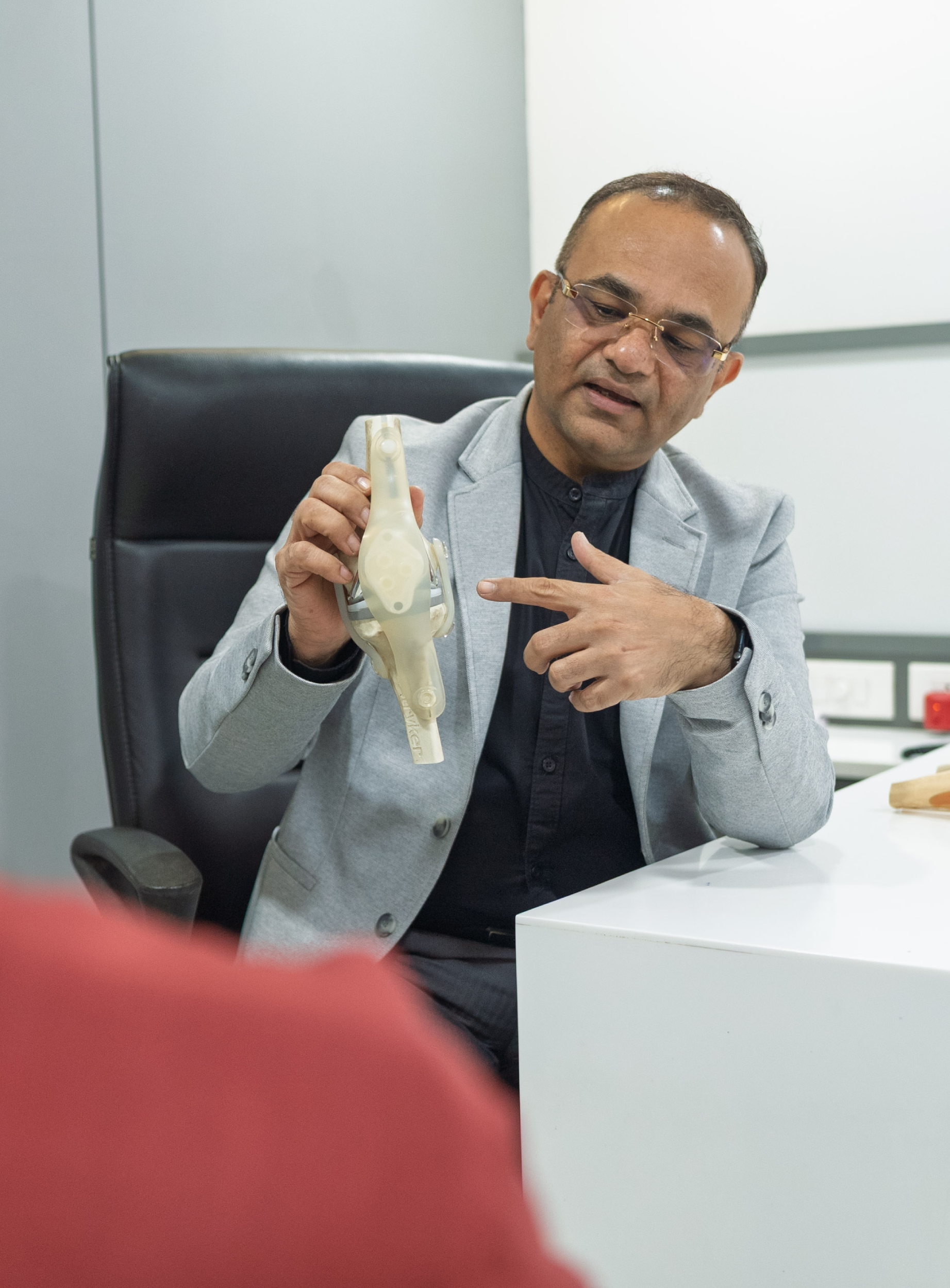




When severe knee pain makes everyday movement a daily struggle, knee replacement surgery offers a proven path back to an active life. However, when patients visit an orthopaedic specialist for a consultation, many are surprised to learn that you don’t always need to replace the entire knee joint.
Depending on the extent of damage inside your knee, you may be a candidate for a Partial Knee Replacement (Unicondylar Knee Arthroplasty) rather than a Total Knee Replacement.
With the arrival of advanced Mako SmartRobotics™ technology in Rajkot, partial knee replacements have become more accurate, predictable, and long-lasting than ever before.
If you are suffering from knee arthritis, here is a detailed breakdown of the differences between partial and total knee replacements, how to know which procedure you need, and why robotic precision is a game-changer for bone-preserving joint surgery.
Understanding Knee Anatomy: The 3 Compartments
To understand the difference between partial and total knee replacement, it helps to view the knee as a building with three distinct rooms (compartments):
-
Medial Compartment: The inner side of the knee (closest to your other knee). This is where osteoarthritis usually strikes first.
-
Lateral Compartment: The outer side of the knee.
-
Patellofemoral Compartment: The front of the knee behind the kneecap (patella).
   [ Medial (Inner) ]    |    [ Lateral (Outer) ]
                         |
             [ Patellofemoral (Front/Kneecap) ]
-
Partial Knee Replacement: Only one damaged compartment is resurfaced with metal and plastic implants, leaving the healthy bone, cartilage, and natural ligaments (including the ACL and PCL) completely intact.
-
Total Knee Replacement: All three compartments are resurfaced when arthritis has spread throughout the entire joint.
Partial vs. Total Knee Replacement: At-a-Glance Comparison
| Parameter | Partial Knee Replacement (PKR) | Total Knee Replacement (TKR) |
| Surgical Scope | Resurfaces only 1 affected compartment | Resurfaces all 3 joint compartments |
| Natural Bone Preserved | 70% to 80% of healthy bone preserved | Removes damaged bone across the full joint surface |
| Natural Ligaments Retained | ACL & PCL ligaments remain intact | ACL is replaced; PCL depends on implant design |
| Incision Size | Smaller incision (approx. 3–4 inches) | Standard incision (approx. 6–8 inches) |
| Joint Feeling | Feels almost identical to a natural knee | Stable, comfortable, but takes time to adapt |
| Recovery & Rehab | Faster (Walk within hours; back to routine in 2–3 weeks) | Standard (Back to full routines in 4–6 weeks) |
Am I a Candidate for Partial Knee Replacement?
Not everyone with knee pain qualifies for a partial knee replacement. A thorough clinical evaluation and high-resolution imaging by an arthroplasty specialist will determine your eligibility.
You May Be an Ideal Candidate for Partial Knee Surgery If:
-
Your arthritis is strictly confined to only one compartment (most commonly the inner/medial side).
-
Your anterior cruciate ligament (ACL) is intact and healthy.
-
You do not have severe knee stiffness or major angular deformities (e.g., severe bowing of the legs).
-
You do not suffer from inflammatory systemic conditions like advanced Rheumatoid Arthritis (which eventually affects all compartments).
You Need a Total Knee Replacement If:
-
Osteoarthritis has spread to two or all three compartments of your knee.
-
There is significant ligament instability or severe deformity.
-
You have advanced rheumatoid arthritis affecting the whole joint.
Why Robotic Assistance is Essential for Partial Knee Replacements
Historically, traditional manual partial knee replacement was considered technically challenging. Because the surgeon replaces only a small segment of the joint, getting the alignment exactly right was difficult using manual tools. If the implant was off by even 1 or 2 millimeters, the remaining natural cartilage would wear out quickly.
Mako SmartRobotics™ has revolutionized partial knee replacement:
[ Pre-Op 3D CT Scan ] ➔ Maps the single damaged compartment down to <1 mm
                                 ↓
[ Dynamic Balancing ] ➔ Tests natural ACL/PCL ligament tension before cutting
                                 ↓
[ Haptic AccuStop™ ]  ➔ Prevents tool from touching healthy adjacent cartilage
-
Precision Boundary Protection: The robotic arm’s haptic technology restricts bone preparation strictly to the diseased compartment. Healthy cartilage and bone are left completely untouched.
-
Sub-Millimeter Alignment: Ensures the artificial insert transitions seamlessly into your natural cartilage, eliminating unnatural friction.
-
Perfect Ligament Balancing: Preserves your natural ACL and PCL tension so the knee bends and twists smoothly without feeling loose.
Clinical Benefits of Robotic Partial Knee Replacement
Patients who undergo robotic partial knee replacement experience significant advantages:
-
Natural Knee Motion: Because your ACL, PCL, and healthy cartilage are preserved, the knee retains its natural proprioception (your brain’s ability to feel joint position). Patients often forget they even have an artificial implant.
-
Minimal Blood Loss & Pain: A smaller incision and localized bone work mean minimal soft-tissue disruption and significantly lower post-op soreness.
-
Rapid Discharge & Recovery: Most patients stand and walk within hours of surgery and are discharged from the hospital in 1 to 2 days.
-
Easier Bending & Squatting: Preserved ligaments allow for a fuller, more natural range of motion.
Expert Joint Preservation Care in Rajkot: Dr. Ketan Shah
Choosing between partial and total knee replacement requires precise diagnostic judgment. Recommending a partial knee replacement when a total replacement is needed—or performing a total replacement when a partial would suffice—can compromise your long-term results.
At Prabhukrupa Hospital in Rajkot, patients benefit from the expertise of Dr. Ketan Shah:
-
21+ Years of Arthroplasty Leadership: Saurashtra’s first DNB-credentialed exclusive joint replacement specialist (since 2003).
-
Mastery in Bone Preservation: Extensive experience performing both partial and total robotic knee replacements customized to patient anatomy.
-
Stryker National Faculty & Mentor: Training orthopaedic surgeons across India in advanced Mako robotic procedures and joint-sparing techniques.
Find Out Which Procedure is Right for Your Knees
Living with knee pain does not automatically mean you need a complete joint overhaul. Through precise 3D CT diagnostics and Mako SmartRobotics™, you may be able to save up to 80% of your natural knee.
Visit Prabhukrupa Hospital in Rajkot for a comprehensive joint evaluation and personalized surgical plan.
Schedule Your Knee Evaluation
-
Hospital Address: Prabhukrupa Hospital, Opposite Senior Citizen Park, Near Jubilee Garden, Kasturba Road, Rajkot – 360001.
-
Appointment Line: +91 9898 778 541
-
Official Website: drketanshahortho.com | prabhukrupahospital.com