



Is Revision Knee Replacement Available in Rajkot? Signs You Need a Second Joint Surgery
A primary knee replacement is meant to restore freedom of movement and allow you to live without pain for decades. Millions of people around the world enjoy 15, 20, or even 25 years of active living after their initial knee surgery.
However, artificial joints—just like natural bones and cartilage—are subject to mechanical wear and tear over time. In some cases, a previously replaced knee joint may begin to feel loose, unstable, or painful again.
When an artificial knee fails or wears out, a specialized procedure called Revision Knee Replacement (or Redo Knee Surgery) is required.
If you or a loved one in Saurashtra are experiencing pain in a knee that was operated on years ago, you might be asking:
“Do we need to travel to a metro city like Mumbai or Ahmedabad for a complex redo knee surgery, or is revision knee replacement available right here in Rajkot?”
The short answer is yes. Advanced revision knee replacement is fully available in Rajkot, delivered with international-standard precision and specialized surgical expertise.
What is a Revision Knee Replacement?
While a primary knee replacement involves replacing damaged natural bone and cartilage with an artificial implant, a revision knee replacement involves removing part or all of the original artificial implant and replacing it with specialized, highly stable revision components.
Revision knee surgery is technically more complex than a first-time replacement because:
-
The surgeon must carefully remove the existing metal/plastic implant without damaging remaining healthy bone.
-
There is often bone loss around the old implant that requires specialized metal augments, stems, or bone grafts.
-
The surrounding ligaments may be weakened, requiring constrained, high-stability revision implants.
Because of these complexities, revision joint surgery requires a senior arthroplasty specialist with dedicated training in complex joint reconstruction.
5 Clear Signs You Might Need a Second Knee Surgery
If you had a knee replacement years ago and are noticing new or unusual symptoms, it is crucial not to ignore them. Here are the most common warning signs that your implant may need evaluation for a revision:
[ New or Worsening Knee Pain ]
              ↓
[ Unsteadiness / Knee "Giving Way" ]
              ↓
[ Persistent Swelling & Warmth ]
              ↓
[ Reduced Range of Motion / Stiffness ]
              ↓
[ Clinical & X-Ray / CT Evaluation ]
1. New or Gradually Worsening Pain
While mild muscle soreness during heavy activity can be normal, deep, aching pain inside the joint—especially when bearing weight, standing up, or walking—is the primary red flag. Pain that returns after years of being pain-free often indicates implant loosening or wear.
2. Knee Instability or “Giving Way”
If your knee feels wobbly, unsteady, or buckles beneath you when taking a step, the ligaments supporting your artificial joint may have stretched out, or the internal plastic spacer (polyethylene insert) may have worn down.
3. Persistent Swelling, Warmth, or Stiffness
Ongoing fluid buildup around the knee joint accompanied by localized heat, skin redness, or a sudden loss of flexibility (difficulty bending or straightening the leg) warrants an immediate orthopaedic assessment.
4. Difficulty Walking or Standing
If you suddenly find yourself relying heavily on a walking stick or walker again after years of unassisted walking, it indicates the joint’s mechanical alignment has altered.
5. Signs of Deep Infection (Uncommon but Serious)
Infection around an artificial joint can occur months or years after surgery. Signs include fever, chills, persistent redness, warmth, or drainage around the surgical scar. Deep infections require prompt surgical cleaning or staged component revision to protect the joint.
Common Causes of Knee Implant Failure
Understanding why an artificial knee fails helps in choosing the right corrective treatment:
| Cause of Failure | What Happens Inside the Joint | Typical Timeline |
| Aseptic (Non-Infectious) Loosening | The bone-implant bond weakens over time due to natural friction and body weight friction. | 15 to 20+ years post-op |
| Polyethylene Wear | The durable plastic insert between metal components wears thin, causing bone-on-metal friction. | 10 to 20 years post-op |
| Joint Instability | Ligaments become lax, causing the knee to feel loose or slip out of alignment. | Any time post-op |
| Periprosthetic Fracture | A fall or impact fractures the bone directly surrounding the artificial metal implant. | Trauma-dependent |
| Deep Joint Infection | Bacteria attach to the implant surface, creating a protective biofilm. | Early or late post-op |
Why Primary vs. Revision Surgery Requires Different Expertise
Not every orthopaedic surgeon who performs primary knee replacements undertakes revision procedures. Revision surgery requires specialized anatomical mapping, dynamic balancing, and expert handling of altered bone structures.
Primary Joint Surgery               Revision / Redo Joint Surgery
---------------------               -----------------------------
• Standard bone cuts                • Implant extraction & bone preservation
• Standard implant sizes            • Specialized stems, augments & custom fits
• Intact natural ligaments          • Rebuilding joint stability & alignment
• Straightforward recovery          • Customized, multi-stage rehab care
Advanced Revision Joint Care in Rajkot: Dr. Ketan Shah
Patients across Rajkot, Jamnagar, Junagadh, Amreli, and the wider Saurashtra region no longer need to undergo stressful travel to metro cities for complex joint revisions.
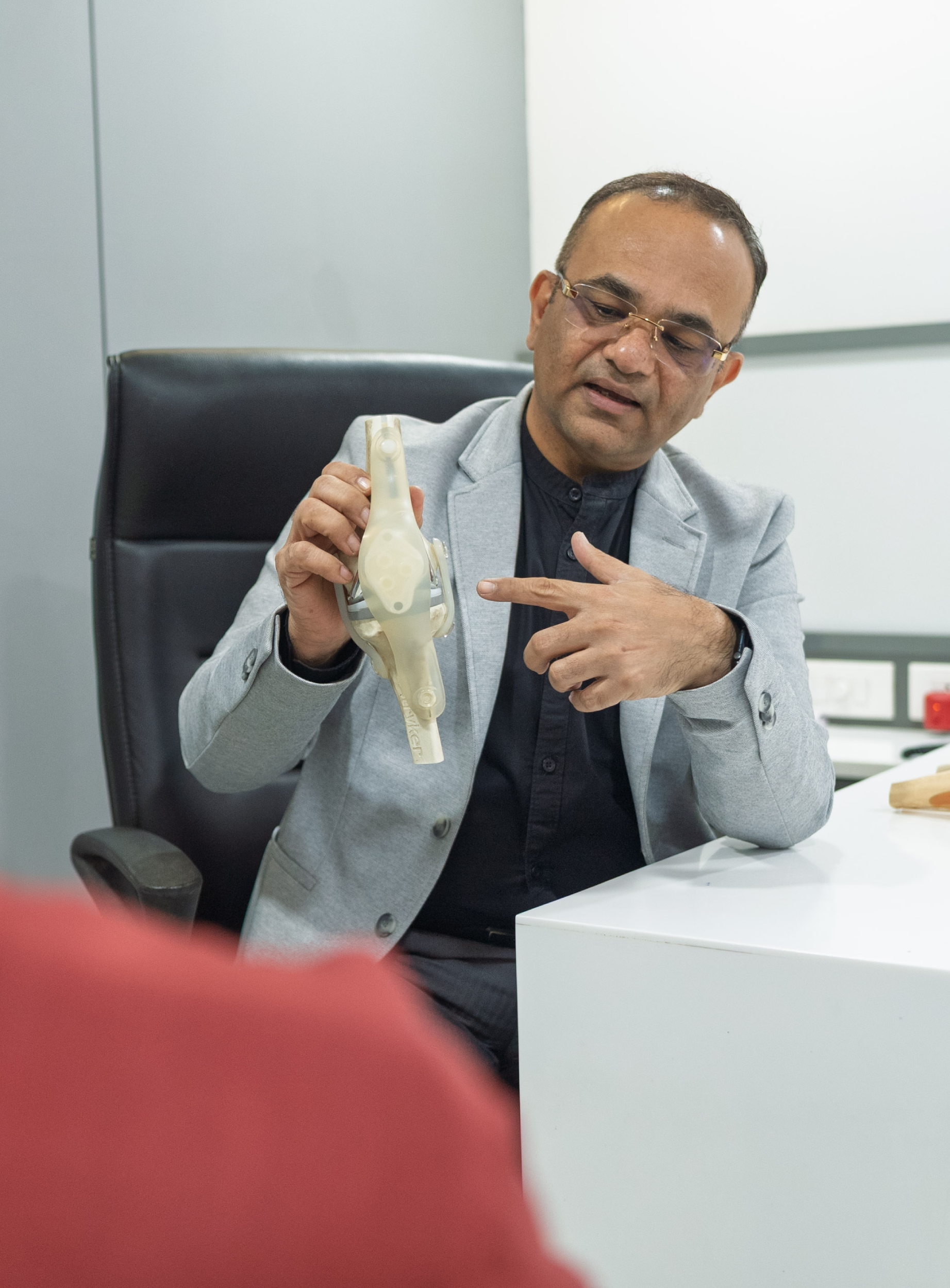
At Prabhukrupa Hospital in Rajkot, revision joint procedures are led by Dr. Ketan Shah, one of western India’s most experienced arthroplasty specialists:
-
300+ Complex Revision / Redo Surgeries: Extensive hands-on experience in successfully re-operating on failed, loose, or painful primary knee and hip implants.
-
21+ Years of Super-Specialized Practice: Saurashtra’s first DNB-credentialed exclusive joint replacement surgeon (since 2003).
-
3D CT-Based Pre-Surgical Planning: Utilizing advanced 3D digital imaging to assess bone loss and map out exact revision stem placement before entering the operating room.
-
Stryker Global Mentor & Faculty: Recognized nationally and internationally for training fellow surgeons in complex joint reconstruction techniques.
What to Expect During a Revision Consultation
If you visit Prabhukrupa Hospital for a secondary knee evaluation, your diagnostic assessment will include:
-
Detailed Clinical History: Reviewing your original surgical records, implant details, and symptom progression.
-
High-Resolution X-Rays & 3D Imaging: To detect sub-millimeter implant movement, bone loss, or alignment shifts.
-
Blood Tests & Joint Aspiration (if needed): To rule out hidden low-grade infections before planning surgical corrections.
-
Customized Revision Blueprint: A clear, step-by-step discussion on the exact surgical plan, expected recovery timeline, and rehabilitation goals.
Frequently Asked Questions (FAQs)
Q1. Is a revision knee replacement more painful than the first surgery?
With modern regional anesthesia, nerve blocks, and minimally disruptive surgical techniques, post-operative pain is well-controlled. Most patients experience significant pain relief compared to the constant pain caused by a loose or failing implant.
Q2. How long does a revision knee implant last?
Modern revision implants crafted with specialized titanium stems and advanced polyethylene inserts can last 15 to 20 years or more, restoring comfortable walking and daily independence.
Q3. Can robotic technology be used for revision knee replacement?
In select revision cases where anatomical landmarks remain intact, 3D robotic planning aids in achieving precise alignment and implant balancing. Dr. Ketan Shah evaluates each case individually to determine the best approach.
Do Not Ignore Persistent Knee Pain After Joint Surgery
A painful or loose knee implant will not fix itself over time. Seeking an early consultation with a revision joint specialist can prevent further bone loss and make your secondary surgery significantly simpler and more successful.
Get expert clarity on your joint health right here in Rajkot.
Consult Dr. Ketan Shah for a Second Opinion
-
Hospital Location: Prabhukrupa Hospital, Opposite Senior Citizen Park, Near Jubilee Garden, Kasturba Road, Rajkot – 360001.
-
Helpline for Appointments: +91 9898 778 541
-
Official Website: drketanshahortho.com | prabhukrupahospital.com